
My Dog Gets Too Excited and Won’t Calm Down. The Problem Isn’t Impulse Control.

A few weeks ago I was at a neighbor’s barbecue with Betsy, a pit bull who is about as sweet as they come and wants nothing more than to say hello to everyone she meets. Betsy’s owner manages all that enthusiasm by keeping a lid on it. When people arrive, the rules are clear: don’t greet Betsy, don’t give her much attention, don’t play with her, and whatever you do, don’t let her up in your lap. The reasoning is that if Betsy gets going, she gets too excited and can’t calm herself back down. I am, of course, the person at the barbecue who lets the dog in her lap anyway. So Betsy climbed up, got her massage, and we both had a perfectly nice time.
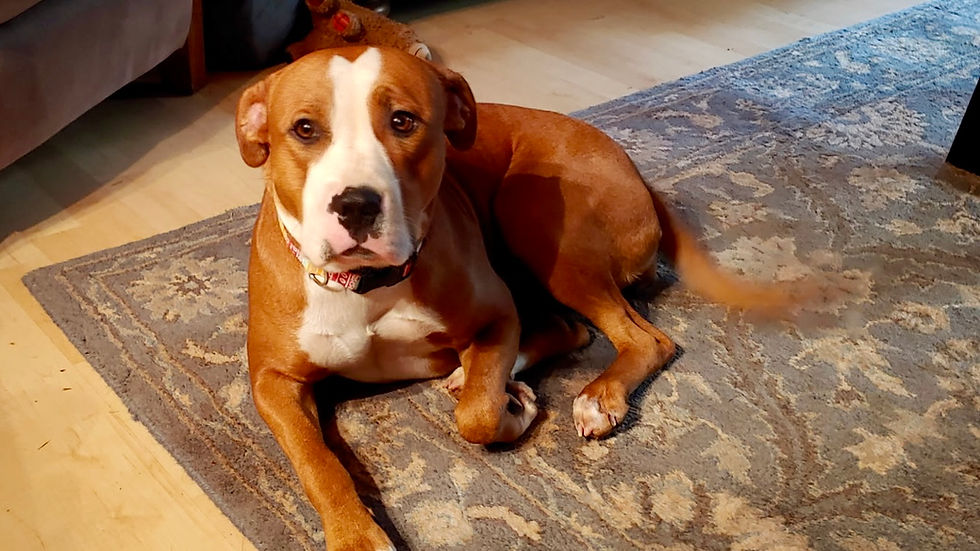
The next time I saw Betsy she was jumping all over me — only me, since everyone else was still doing the usual thing of ignoring her and giving her no attention at all. The verdict from the room was that this was my doing: I’d let her into my lap once, so now she thought she could. Betsy wasn’t jumping because of one lap at one barbecue. She was jumping because she was thrilled that someone was engaging with her and had no idea how to channel that, and she’d never had the chance to learn. The whole strategy had been to keep her from getting excited in the first place, which means the one skill she actually needed — getting worked up and then calming herself back down — was the one skill she’d never been allowed to build.
This usually gets labeled as a lack of impulse control, and that label does more harm than good. It points at some vague quality the dog is missing instead of naming a behavior you can actually teach, and it leaves owners managing the dog’s arousal forever rather than building anything. It is far more useful to decide exactly what you want your dog to do when she’s excited than to chase an abstract trait called impulse control. That’s what I want to get into here.
The advice that backfires: just don’t let your dog get excited
The advice to simply never let your dog get excited shows up more often than I’d like. Don’t play tug, the thinking goes, because it taps into something predatory and winds the dog up — when in fact a good game of tug gives that predatory drive an appropriate outlet. Don’t let your dog into your lap or greet her with any enthusiasm, because you’ll only teach her to jump — when in fact, if I’ve taught my dog what I’d like her to do instead, I can reinforce that every time she wants my attention. In each case the excitement isn’t the problem; the missing piece is a trained alternative.
Impulse control isn’t a fixed trait — it depends on the moment
So the first thing I think about when I’m working on a dog’s impulse control (and I’ll use the label here for simplicity) is defining exactly what I want the dog to do. That is far more productive than trying to install some vague capacity for self-control. Impulse control is a slippery idea to apply to a dog in the first place, because how much of it any of us has in a given moment depends heavily on the conditions. In behavioral terms, motivating operations shift our ability to hold it together.
Picture yourself at the airport, waiting to check in. You left in plenty of time, or so you thought, but parking was a nightmare, the line is twice as long as it should be, the person ahead of you just waved three friends in, and now they’re arguing with the agent at the desk. When someone tells you to be patient and wait your turn, it is genuinely hard, because everything leading up to this moment has chipped away at your reserves.
Now run the same morning the other way: you woke up early, the coffee came out perfect, you sailed into the airport, there was no line, and the agent waved you right through. They ask you to wait a minute at the gate, and it’s no problem at all. Same person, same request, completely different capacity to meet it. Dogs work exactly the same way.
What to train instead: the setup, the behavior, the reinforcement
So once more: clearly define the setup, the behavior you want from your dog, and the reinforcement you plan to use. The next few paragraphs walk through each of those.
Start with the setup — the environment where the behavior actually happens. With Betsy, that moment is when I come over, cross the threshold into the house, and she greets me for the first time. That’s when she’s at her most wound up, and it’s exactly where the jumping and climbing on me shows up. So that’s the situation I’m planning for: not Betsy in general, but Betsy at the front door in the first few seconds.
Next is the behavior I want instead. I’d like to replace the jumping with something smoother she can do in that same excited moment to get my attention. There’s a real menu to choose from. You could send the dog to their bed, or teach a “go find your toy” cue, which I love because it moves her away from the door and pours all that energy into hunting down a ball, or redirect her to a snuffle mat where the sniffing helps settle her nervous system. But the simplest version is to teach the dog one behavior you like and build on it. With Betsy, I’d teach her that a sit earns all the attention she wants, even when she’s excited.
Then there’s the reinforcement. Early on I’ll use plenty of food, because let’s face it, every dog is a foodie, and food is the easiest way to hand out small, repeatable bits of information while she’s still learning. But the real-life reinforcer is my attention. I walk in, she’s thrilled to see me, and she learns that the second she sits, I give her exactly the attention she was after. You can call that impulse control if you like, but it’s really stimulus control — the dog doing the trained behavior on cue.
How to actually build the behavior
Here’s where it’s easy to go wrong, and nearly all of my clients go wrong in the same spot. This isn’t about teaching a sit and then drilling it through progressively harder scenarios. It’s about teaching the dog that when she wants something, certain behaviors work better than others to get it — in Betsy’s case, that’s a sit. I built that idea on purpose, starting with a piece of food in my hand. That manufactures the setup: now the dog wants something from me. At the barbecue she wanted my attention because she was excited to see me, but here the situation is different — she’s already hanging out with me — so I use a bit of food to recreate that same wanting.
The dog can see I’m holding a treat, and I let her try whatever she likes to get it. She might paw at my hand, jump up, mouth at my fingers, or bark, and none of it works — I don’t interrupt any of it, I just hold still and wait. The instant her rear end hits the floor, I say yes and the treat is hers. That’s the whole lesson: she can try anything she wants, but only one behavior pays off. I keep at it until she’s eagerly offering the sit the moment she sees a cookie in my hand.
From there I take it to the spot where I actually want it. First I walk in the front door with a cookie in my hand, she sits, and I toss it to her. Then I take the food out of the picture: I walk in the front door, she sits, and the reward is my attention — the very thing she wanted from me in the first place.
When I think back to Betsy mobbing me at that barbecue, I don’t see a dog with no impulse control. I see a dog who was thrilled to see a person and didn’t know what to do with that feeling. Every other outlet had been closed off — no greeting, no lap, no play — so launching at the one person who engaged with her was the only move she had. That isn’t a character flaw to suppress. It’s a behavior nobody taught her.
Her excitement was never the problem. The problem was that the whole plan was to make it disappear, when what she needed was something to do with it. Decide what you want your dog to do — for Betsy, a sit — teach her it’s how she gets what she wants, and practice it in the moment that counts. Do that, and the excitement stops being something you spend your life managing and turns into something you can actually work with.
If this shifted how you think about your dog’s excitement, it’s the kind of thing I write about regularly. My newsletter goes out to people working through reactivity, anxiety, and over-arousal — the same behavior-first approach you just read, sent straight to your inbox. ➡️ Sign up here


Comments